MasukDaftar
Hari IniArtikelPertempuranBiografiMode cerita

13 Maret 624 M · 17 Ramadan 2 H

The Battle of Badr

غزوة بدر

Siera van de Profeet ﷺ · De Medina Periode

The first major battle in Islamic history. On 17 Ramadan 2 AH (13 March 624), 313 Muslims under the leadership of the Prophet ﷺ defeated a Quraysh army of around 1,000 men at the wells of Badr.

Baca artikel selengkapnya
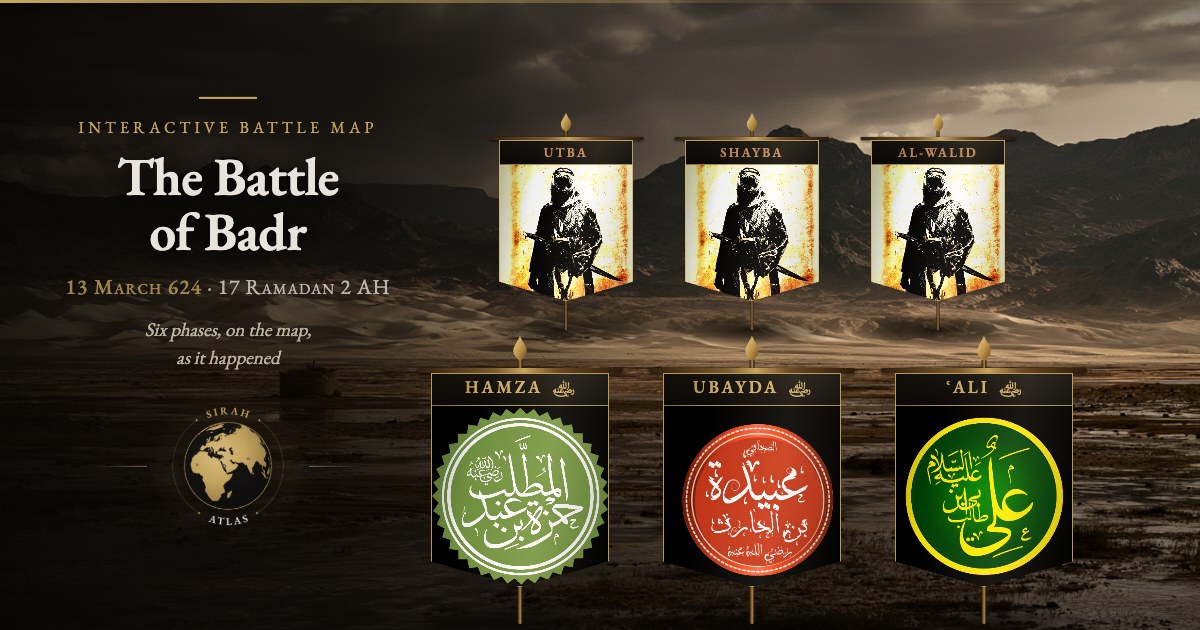
The Battle of Badr, 624 M / 2 H – peta medan perang dari Sirah Atlas, menampilkan panji-panji para panglima yang saling berhadapan di sana.
Tahap 1

The March to Badr

In the month of Ramadan in the second year after the Hijrah (624 CE), the Prophet ﷺ received news that a large trading caravan of the Quraysh, led by Abu Sufyan, was returning from Syria to Makkah. The caravan consisted of around a thousand camels laden with goods, escorted by only thirty to forty guards.

The Prophet ﷺ called on the Muslims to intercept the caravan, and a small group of around 313 Companions was assembled to carry out this task.

Abu Sufyan had meanwhile discovered what the Muslims were planning and sent Damdam ibn Amr al-Ghifari ahead to warn the Quraysh in Makkah and to call for reinforcements. The Quraysh mobilised an army of around 1,000 men, equipped with cavalry (both horses and camels), under the command of Abu Jahl. With great haste they set out for Badr.

Abu Sufyan succeeded in bringing the caravan to safety along an alternative coastal route. He therefore sent word to the Quraysh that the caravan was safe. Yet Abu Jahl refused to turn back. “By Allah, we will not return until we have reached Badr,” he declared.

Tahap 2

Positioning at the Wells

The Muslims reached the plain of Badr first. The Prophet ﷺ initially chose a position by the first well he came across. Then al-Hubab ibn al-Mundhir ﵁ stood up and asked: “O Messenger of Allah, is this position a revelation from Allah, or is it your own judgment?”

The Prophet ﷺ answered that it was his own judgment. Al-Hubab then advised positioning the men at a specific watering point that had more than enough water. All the other wells were filled in so that the Quraysh would have nothing to drink, while the Muslims controlled the only watering point in the valley of Badr.

The Prophet ﷺ accepted this advice immediately. During the night the Muslims advanced and seized the well. They filled in the remaining wells with sand and built a reservoir (hawd) at the controlled well.

Sa’d ibn Mu’adh ﵁, leader of the Aws, proposed building a command post (al-'arish) on a sand dune overlooking the battlefield. From there the Prophet ﷺ would oversee the battle, protected by a guard of Ansar.

That same night, Allah ﷻ sent rain over the battlefield. For the Muslims, the rain made the sandy ground firm, so they could march well. For the Quraysh, who lay on the lower western slope near Mount 'Aqanqal, the ground turned into mud that hampered their movements.

“When He covered you with slumber as a reassurance from Him, and sent down water from the sky upon you, that He might cleanse you thereby” — Surah al-Anfal (8:11)

Tahap 3

Mubaraza

On the morning of 17 Ramadan, 2 AH (13 March 624), the two armies drew up opposite each other in the plain of Badr.

According to Arab military tradition, three champions of the Quraysh stepped forward and demanded a single combat (mubaraza):

  • 'Utba ibn Rabi’a — one of the foremost leaders of the Quraysh
  • Shayba ibn Rabi’a — his brother
  • al-Walid ibn 'Utba — his son

Initially three Ansar stepped forward, but the Quraysh refused them and demanded opponents of equal rank from the Muhajirun. The Prophet ﷺ then sent three of his closest kinsmen:

  • Hamza ibn 'Abd al-Muttalib ﵁ — the uncle of the Prophet ﷺ, “the Lion of Allah”
  • 'Ali ibn Abi Talib ﵁ — the cousin and son-in-law of the Prophet ﷺ
  • 'Ubayda ibn al-Harith ﵁ — the cousin of the Prophet ﷺ

The combats were short and fierce:

'Aliagainst al-Walid: The duel was swift. 'Ali ﵁ killed al-Walid with a single decisive blow.

Hamzaagainst 'Utba: Hamza ﵁ overcame 'Utba in a powerful fight and killed him.

'Ubaydaagainst Shayba: This was the hardest duel. Shayba succeeded in severely wounding 'Ubayda’s leg with his sword, but 'Ali ﵁ and Hamza ﵁ rushed in and killed Shayba. 'Ubayda ﵁ was carried back to the Muslim lines, where he died of his wounds a few days later, the first martyr of Badr.

The outcome of the duels was a heavy moral blow for the Quraysh: three of their foremost warriors had fallen.

Tahap 4

The General Assault

After the duels, Abu Jahl gave the command for a general assault. The Quraysh showered the Muslim lines with a rain of arrows and then charged forward.

The Prophet ﷺ stood at the command post and fervently implored Allah ﷻ for help: “O Allah, if this group perishes today, You will not be worshipped on earth anymore.” Abu Bakr ﵁, who was with him, said: “O Messenger of Allah, your supplication is sufficient, for Allah will fulfil His promise.”

Then the Prophet ﷺ took a handful of sand and threw it in the direction of the Quraysh, exclaiming: “May the faces be darkened!” The dust struck the eyes and noses of many Quraysh fighters and sowed confusion in their ranks.

“And you did not throw when you threw, but it was Allah who threw” — Surah al-Anfal (8:17)

Then the Prophet ﷺ gave the command: “Rise and advance to a Paradise as wide as the heavens and the earth!”

The Muslims charged forward as one. Despite their numerical inferiority, they fought with a conviction and resolve that astonished the Quraysh. The Muslim lines broke through the Quraysh formation.

During the battle, Abu Jahl (Amr ibn Hisham), the supreme commander of the Quraysh, was killed by Mu’adh ibn 'Amr ﵁ and Mu’adh ibn ‘Afra’ ﵁, two young men of the Ansar. His death was confirmed by 'Abdullah ibn Mas’ud ﵁.

Other prominent Quraysh who fell included Umayya ibn Khalaf (killed by Bilal ﵁ and a group of Muslims) and al-'As ibn Sa’id.

The lines of the Quraysh broke and their formation collapsed.

Tahap 5

The Turning Point

The Quraysh fled in panic toward Makkah. The Muslims pursued them and took many prisoners.

The balance

The Battle of Badr ended as a decisive victory for the Muslims:

  • 70 Quraysh fighters were killed, among them many tribal chiefs and leaders
  • 70 Quraysh fighters were taken captive
  • 14 Muslims fell as martyrs: 6 Muhajirun and 8 Ansar

Among the slain Quraysh leaders were:

  • Abu Jahl (Amr ibn Hisham) — the supreme commander
  • 'Utba ibn Rabi’a — one of the three duellists
  • Shayba ibn Rabi’a — his brother
  • al-Walid ibn 'Utba — son of 'Utba
  • Umayya ibn Khalaf — one of the fiercest enemies of Islam

The treatment of the prisoners

The Prophet ﷺ treated the prisoners with mercy. They were distributed among the Companions with the instruction to treat them well. Some prisoners could buy their freedom by paying ransom; others, who could read and write, gained their freedom by each teaching ten Muslim children to read.

The significance

The Battle of Badr was the first major military encounter in Islamic history. The victory, achieved despite a numerical inferiority of nearly one to three, enormously strengthened the position of the young Muslim community in Madinah and proved that the Quraysh, despite their superiority in numbers and equipment, were not invincible.

In the Qur’an this day is referred to as Yawm al-Furqan — “the Day of Distinction” — the day on which truth and falsehood were separated from each other.

“Indeed, Allah helped you at Badr when you were weak. So fear Allah, that you may be grateful.” — Surah Aal-Imran (3:123)

Tahap 6

The Victory

The Quraysh returned home, and the mood in Makkah was one of disbelief and confusion. The Muslims had taken the first step towards establishing their position in the Arabian Peninsula. The Quraysh, however, would soon be looking for revenge…

The Battle of Badr – Peta

Perang ini dapat diikuti tahap demi tahap di peta 3D interaktif, dari gerakan pembuka hingga hasil akhirnya. Peta ini mencakup tahap-tahap berikut:

  • Tahap 1:The March to Badr
  • Tahap 2:Positioning at the Wells
  • Tahap 3:Mubaraza
  • Tahap 4:The General Assault
  • Tahap 5:The Turning Point
  • Tahap 6:The Victory
Buka peta perang interaktif

Tanya Jawab

Siapa yang memenangkan Pertempuran Badar?

Pertempuran Badar, yang berlangsung pada 17 Ramadan 2 H (13 Maret 624 M), berakhir dengan kemenangan telak bagi sekitar 313 Muslim yang dipimpin oleh Nabi Muhammad ﷺ. Mereka mengalahkan pasukan Quraisy yang berjumlah sekitar 1.000 orang di sumur-sumur Badar. Sekitar 70 pejuang Quraisy tewas, termasuk banyak pemimpin kabilah, dan 70 orang ditawan, sedangkan 14 Muslim gugur sebagai syuhada. Kemenangan tersebut membuktikan bahwa Quraisy, meskipun unggul dalam jumlah dan perlengkapan, bukanlah kekuatan yang tidak terkalahkan.

Mengapa Pertempuran Badar terjadi?

Pertempuran Badar bermula pada Ramadan 2 H (Maret 624 M), ketika Nabi ﷺ menyerukan kepada kaum Muslim untuk mencegat kafilah dagang besar Quraisy yang dipimpin Abu Sufyan. Setelah itu, Makkah mengirimkan pasukan sekitar 1.000 orang di bawah pimpinan Abu Jahal, dan kedua pihak bertemu di sumur-sumur Badar. Kafilah itu sendiri lolos melalui jalur pesisir, tetapi Abu Jahal menolak berbalik dan bersumpah tidak akan pulang sebelum mencapai Badar. Dengan demikian, sebuah misi pencegatan berubah menjadi pertempuran besar pertama dalam sejarah Islam.

Berapa jumlah pasukan di masing-masing pihak dalam Pertempuran Badar?

Dalam Pertempuran Badar, sekitar 313 Muslim, yang terdiri atas sekitar 240 prajurit infanteri, 70 pemanah, dan hanya dua ekor kuda, menghadapi pasukan Quraisy yang berjumlah sekitar 1.000 orang, dengan sekitar 700 prajurit infanteri, 200 pemanah, dan 100 pasukan berkuda. Ketimpangan jumlahnya hampir satu berbanding tiga. Meskipun kalah jumlah sedemikian besar, kaum Muslim di bawah kepemimpinan Nabi ﷺ meraih kemenangan telak.

Kapan Pertempuran Badar berlangsung?

Pertempuran Badar berlangsung pada 17 Ramadan tahun kedua setelah Hijrah, bertepatan dengan 13 Maret 624 M dalam kalender Masehi, ketika pasukan kaum Muslim dan Quraisy berbaris saling berhadapan pada pagi hari di dataran Badar. Dalam Al-Qur'an, hari ini disebut Yaumul Furqan, Hari Pembeda, yakni hari ketika kebenaran dan kebatilan dipisahkan satu sama lain.

Apa yang terjadi pada Abu Jahal dalam Pertempuran Badar?

Abu Jahal, panglima tertinggi pasukan Quraisy dalam Pertempuran Badar, terbunuh dalam pertempuran pada 17 Ramadan 2 H (13 Maret 624 M) oleh Mu'adz bin 'Amr ﵁ dan Mu'adz bin 'Afra' ﵁, dua pemuda dari kaum Ansar. Kematiannya dipastikan oleh Abdullah bin Mas'ud ﵁. Para pemimpin Quraisy terkemuka lainnya juga gugur bersamanya, termasuk Umayyah bin Khalaf, yang menjadi pukulan berat bagi kepemimpinan Makkah.

Apakah malaikat turut serta dalam Pertempuran Badar?

Al-Qur'an menyatakan bahwa Allah ﷻ mendukung kaum beriman dalam Pertempuran Badar dengan para malaikat: Surah al-Anfal (8:9) menyebutkan janji seribu malaikat yang datang berturut-turut, dan Surah Ali Imran (3:123-125) mengingatkan bagaimana Allah ﷻ menolong kaum Muslim di Badar ketika mereka dalam keadaan lemah. Bagi kaum Muslim, hal ini menegaskan bahwa kemenangan tersebut terutama merupakan pertolongan dari Allah ﷻ; mengenai pertempuran itu, Al-Qur'an menyatakan bahwa bukan kaum Muslim yang melempar ketika mereka melempar, melainkan Allah ﷻ yang melempar (Surah al-Anfal 8:17).

Mengapa Pertempuran Badar begitu penting?

Pertempuran Badar merupakan pertempuran militer besar pertama dalam sejarah Islam. Kemenangan pada 17 Ramadan 2 H (13 Maret 624 M), yang diraih meskipun jumlah pasukan hampir satu berbanding tiga, sangat memperkuat kedudukan komunitas Muslim yang masih muda di Madinah. Kekalahan itu juga membuat Quraisy kehilangan banyak pemimpin utamanya, termasuk Abu Jahal. Dalam Al-Qur'an, hari tersebut disebut Yaumul Furqan, Hari Pembeda.