THE HIJAZ · WESTERN ARABIA
Madinah in 622–624 CE
This model explores the oasis of Madinah, known before the Hijrah as Yathrib, in the first years after the Prophet Muhammad ﷺ arrived: from his arrival at Quba in Rabi' al-Awwal 1 AH (September 622 CE) to just before Badr in Ramadan 2 AH (March 624 CE).
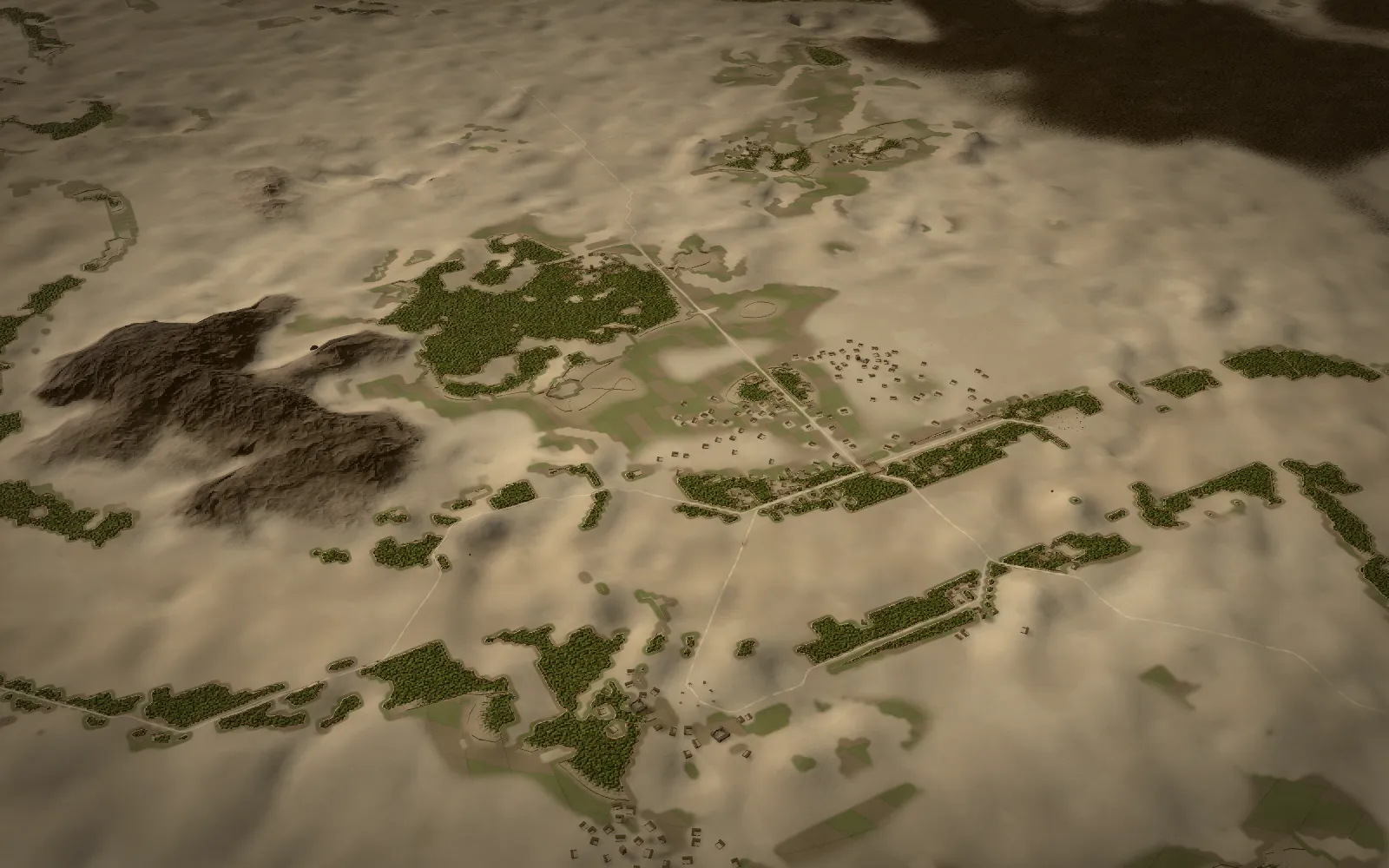
It is a study of the landscape, not a surveyed archaeological reconstruction.
The first mosque is shown as a mud-brick enclosure of about 35 × 30 m on stone footings, with palm-trunk columns, a palm-frond shade and stone doorposts, and the two rooms of Sawdah ﵂ and 'A'ishah ﵂ on its east side. The qibla setting changes it: before Rajab or Sha'ban 2 AH the shade is on the north and the doors face south, east and west; afterwards a shade stands along the south wall, the south door is walled up, a north door opens and the old northern shade becomes the suffa. Masjid Quba, a modest enclosure, changes with it. Around them are the hamlets of the Ansar and the Jewish tribes: about seventy stone-and-mud tower-houses (atam), three walled fortresses, some 470 courtyard houses, mostly single-storey and densest around the mosque among Banu al-Najjar, and over a thousand walled palm gardens covering about a sixth of the oasis floor: densest in the 'Aliya to the south, in belts along the wadis and in patches beside the hamlets of the north, with fields and irrigated ground around them. Close up every palm is modelled; from afar the groves are drawn into the ground as canopy. Their extent is an assumption; that the oasis lived from its walled palm gardens is not. There are also the market of Banu Qaynuqa', the open market ground west of the mosque (date uncertain), a few low graves at Baqi' and a crossing over Buthan. Paler tracks join sourced places such as Quba and the mosque; fainter ones are assumed links.
Almost every building except the two mosques, the rooms and the fort of Ka'b ibn al-Ashraf is a placeholder for a pattern the sources describe, not a known building: the number, height and place of each tower, house and garden are assumptions, recorded as such in the settlement evidence. Places without a mapped site, such as the house of Abu Ayyub ﵁, the market ground and the quarter of Banu Qaynuqa', are placed at illustrative anchors and say so. The centre of the first mosque is placed from the room of 'A'ishah ﵂, not from the modern mosque. Places whose fame comes later are labelled with their date, such as Uhud (battle 3 AH); the Eid prayer ground, the trench and every battle feature are left out. There are no domes, minarets or stone columns, and no human figures: the Prophet ﷺ and his Companions ﵃ are never depicted.
Places in the model
The Prophet's Mosque, first build (1 AH)
Soon after the Hijrah the Prophet Muhammad ﷺ built the mosque on a walled palm garden of Banu al-Najjar. Its pagan graves were cleared, the ruins levelled and the palms cut and laid in a row on the qibla side, with stone doorposts (Sahih al-Bukhari 428). The walls were mud brick on stone footings, the columns palm trunks and the roof palm fronds (Sahih al-Bukhari 446). The enclosure reportedly measured about 70 × 60 cubits, roughly 35 × 30 m. For sixteen or seventeen months its qibla faced north, toward Bayt al-Maqdis (Sahih al-Bukhari 40). Use the qibla setting to see the change of Rajab or Sha'ban 2 AH.
Dwellings of the Prophet ﷺ
Small mud-brick rooms roofed with palm fronds against the east side of the mosque. In 622–624 CE there were two, for Sawdah ﵂ and 'A'ishah ﵂. The room of 'A'ishah ﵂ later became the grave of the Prophet ﷺ, which is what fixes this anchor.
Masjid Quba
In upper Madinah among Banu 'Amr ibn 'Awf, where the Prophet ﷺ stayed fourteen nights on arrival (Sahih al-Bukhari 428) and the first mosque of the Hijrah was founded. The people of Quba learned of the change of qibla at the dawn prayer and turned from the direction of al-Sham to the Ka'bah (Sahih al-Bukhari 403).
Baqi' al-Gharqad
Ground of gharqad scrub east-south-east of the mosque. Its first burials fall in this period: As'ad ibn Zurarah ﵁ in Shawwal 1 AH and, by some reports, 'Uthman ibn Maz'un ﵁ in 2 AH (others give 3 AH).
Masjid Bani Salimah (al-Qiblatayn)
The prayer place of Banu Salimah near Wadi al-'Aqiq. Reports via Ibn Sa'd ﵀, phrased "it was said", place the turning of the qibla here during a prayer in Rajab or Sha'ban 2 AH. Ibn Hajar ﵀ and Ibn Kathir ﵀ weigh this against the report from Quba.
Bir Rumah
A sweet-water well in lower Wadi al-'Aqiq. In the wording of al-Tirmidhi, when the Prophet ﷺ came to Madinah it had no sweet water except Rumah, and he asked who would buy it for the Muslims; 'Uthman ﵁ did so (al-Tirmidhi 3703). The wording in al-Bukhari says "whoever digs" it (Sahih al-Bukhari 2778).
Bayruha' (Bir Ha')
The palm garden and well of Abu Talha ﵁, who owned the most palms among the Ansar. It faced the mosque, and the Prophet ﷺ drank from its sweet water (Sahih al-Bukhari 1461). The gift of the garden came later than this scene.
Banu Qaynuqa'
A Jewish tribe of goldsmiths living inside the town near the bridge over Wadi Buthan, with two fortresses and a market named after them. They were present throughout this scene; their expulsion in Shawwal 2 AH came after Badr.
Banu al-Nadir
The wealthiest Jewish landholders, with palm groves and fortified houses on Wadi Buthan in the fertile 'Aliya, about two miles from the town toward Quba. Their expulsion in 4 AH is later than this scene.
Banu Qurayza
Palm groves and fortresses on Wadi Mahzur against the eastern harra, east of the lands of al-Nadir. They were present throughout this scene; the siege is 5 AH.
Sal'
A dark gabbro hill just north-west of the mosque, bordering the lowest part of the market. Its later role in the siege of 5 AH is outside this scene.
Uhud
A long mountain of red rhyolite about 6 km north of the mosque, closing the oasis to the north. The battle of Uhud (Shawwal 3 AH) is later than this scene, and no battle features are shown.
'Ayr
A long, dark, flat-topped mountain south-west of the oasis, named in hadith as the southern limit of the haram of Madinah.
Harrat Waqim
The eastern lava field: a plateau of dark, broken basalt bounding the oasis on the east, toward the lands of Qurayza and Banu 'Abd al-Ashhal. It is old basalt, not flowing lava.
Harrat al-Wabra
The western lava field beyond Wadi al-'Aqiq: dark basalt ground between the older hills west of the oasis.
Wadi al-'Aqiq
The western wadi, running north toward al-Zughaba, where the valleys of Madinah unite. Bir Rumah and the lands of Banu Salimah lie near it.
Wadi Buthan
"Our wadi", the people of Madinah called it, as Ibn Sa'd ﵀ reports. It ran from the south, east of Quba, into the town between the houses on its west side, then north. A bridge over it led to Banu Qaynuqa' and on toward Quba.