MAKKAH · THE SANCTUARY
The Ka'bah as Quraysh Rebuilt It, c. 605 CE
This page rebuilds the Ka'bah (Kaaba) in Makkah (Mecca) as Quraysh rebuilt it about 605 CE, when the Prophet ﷺ was thirty-five and the first revelation was still five years away.
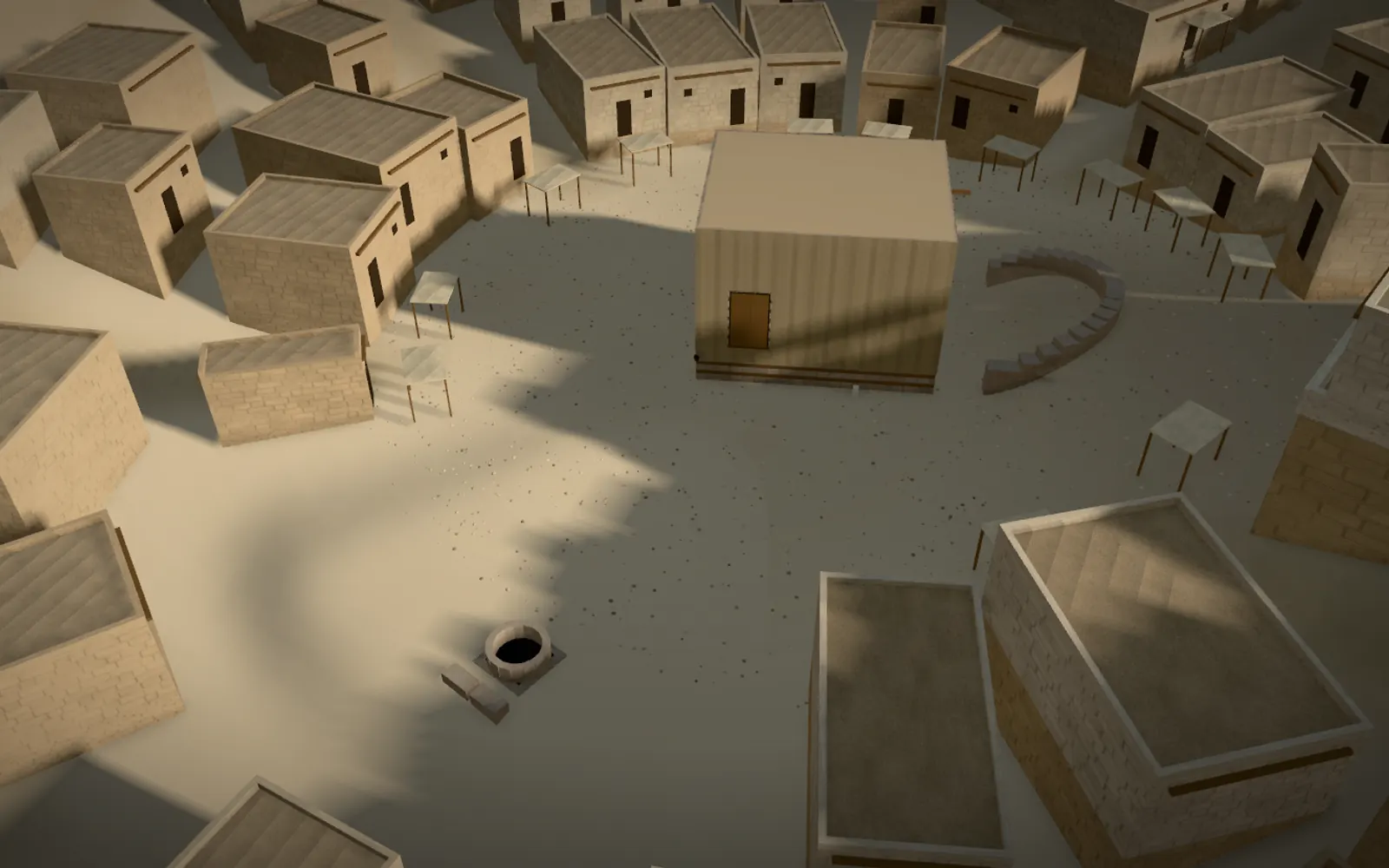
The model shows a House of stone and ship timber 18 cubits high under a flat roof, with its single door raised above the ground, the Black Stone in its eastern corner, the part of the foundation of Ibrahim ﵇ that was left outside the walls, and the well of Zamzam in the open sanctuary around it. You can orbit it, look at the door and the Black Stone up close, or see the sanctuary from above. Every place below is described as the sources describe it, with a note on where the model places it, what it assumes and where each claim comes from, and each one opens in the 3D model.
The rebuilding of the Ka'bah by Quraysh
Before 605 the Ka'bah was a roofless enclosure of dry-laid stones, a little higher than a man or nine cubits high in the report of al-Azraqi ﵀, and its door lay at ground level (al-Sira al-Nabawiyya 1:193; Akhbar Makka 1:159, 1:164 and 1:288). Three things are given as the reasons it was pulled down: a fire, started by a woman's censer, that burnt the layered coverings and weakened the walls; a flood that cracked them; and the theft of the treasure kept in a pit inside (Akhbar Makka 1:158 to 1:160; al-Sira al-Nabawiyya 1:193). Ibn Ishaq ﵀ dates the rebuilding to the year the Prophet ﷺ turned thirty-five, about 605 CE (al-Sira al-Nabawiyya 1:192), and Jabir ibn 'Abd Allah ﵁ reports that the Prophet ﷺ carried stones for it together with his uncle al-Abbas (Sahih al-Bukhari 1582, 3829).
The timber came from a Byzantine ship wrecked on the coast, at al-Shu'aybah in the account of al-Azraqi ﵀ or at Jeddah in that of Ibn Ishaq ﵀, and Quraysh bought its wood for the roof; a carpenter named Baqum in the account of al-Azraqi ﵀ worked on the building, while Ibn Ishaq ﵀ speaks of a Coptic carpenter living in Makkah (Akhbar Makka 1:160 and 1:164; al-Sira al-Nabawiyya 1:193). The walls rose in alternating courses, sixteen of stone with fifteen of timber between them, stone at the top and at the bottom (Akhbar Makka 1:163 to 1:164). When the old walls were taken down, the diggers reached the foundation of Ibrahim ﵇, green stones set against one another like the humps of camels (al-Sira al-Nabawiyya 1:195; Sahih al-Bukhari 1586).
Quraysh had agreed to put nothing into the building but money honestly earned, with no bride-price of a prostitute, no gain from usury and nothing taken from anyone by wrong. Ibn Ishaq ﵀ gives these words to Abu Wahb ibn 'Amr of Makhzum and notes that people also ascribed them to al-Walid ibn al-Mughirah, who speaks them in the account of al-Azraqi ﵀ (al-Sira al-Nabawiyya 1:194; Akhbar Makka 1:161 to 1:162). That money ran short, so they left part of the foundation of Ibrahim ﵇ outside the new walls on the north-west side and marked it with a low round wall, as the Prophet ﷺ later told 'A'ishah ﵂ when she asked whether that wall belonged to the House (Sahih al-Bukhari 1584; Akhbar Makka 1:163). The new House was hung with striped Yemeni cloth (the sources also mention Egyptian linen); its colour is not recorded (Akhbar Makka 1:167; al-Sira al-Nabawiyya 1:199). Its keepers were Banu 'Abd al-Dar, and while the work went on its treasure and ornaments were left with one of them, Abu Talhah 'Abd Allah ibn 'Abd al-'Uzza (Akhbar Makka 1:166).
The Ka'bah of Quraysh

About 605 CE, when the Prophet ﷺ was thirty-five, Quraysh pulled down the old Ka'bah, a roofless enclosure of dry stone little higher than a man, and built it again. A fire and a flood had weakened its walls, and its treasure had been stolen. They laid sixteen courses of stone with fifteen courses of timber between them, the wood bought from a Byzantine ship wrecked on the coast (at al-Shu'aybah or at Jeddah, as the accounts differ), and a carpenter named Baqum in the account of al-Azraqi ﵀ worked on it. The new House rose 18 cubits, twice its old height, under a flat roof carried on six columns (Sahih Muslim 1333f), and was hung with striped Yemeni cloth (the sources also mention Egyptian linen); its colour is not recorded. Its keepers were Banu 'Abd al-Dar.
- Location
- The mapped outline of the Ka'bah, which follows the foundations laid by Quraysh · position: high confidence
- Reconstruction
- Modelled 8.69 m high (18 cubits of 0.4825 m) on the mapped outline of 11.9 by 10.2 m. The courses show only on the strip below the cloth; their heights (stone 0.34 m, timber 0.22 m) are an assumption, as are the colour of the cloth and its stripes. There is no gold band, no inscription and no black cloth: all of these came later.
- Sources
- Mapped site, openstreetmap.org ↗
- Hadith, sunnah.com ↗
- Hadith, sunnah.com ↗
- Arabic source, shamela.ws ↗
- Arabic source, shamela.ws ↗
- Arabic source, shamela.ws ↗
- Ibn Hisham, al-Sira al-Nabawiyya, ed. al-Saqqa, 1:192–199
The Black Stone and the arbitration
When the walls reached the corner of the Black Stone, the clans of Quraysh quarrelled over which of them would have the honour of setting it in place. The quarrel lasted four or five nights, in the account of Ibn Ishaq ﵀, until Abu Umayyah ibn al-Mughirah proposed that the first man to enter the sanctuary should judge between them, and they agreed (al-Sira al-Nabawiyya 1:196 to 1:197; Akhbar Makka 1:163). The first to come in was the Prophet ﷺ. He called for a cloth, or spread his own cloak in the report of al-Azraqi ﵀, laid the stone on it, had one man from each quarter of Quraysh lift a side, and when they had raised it to its place he set it in the eastern corner with his own hand (al-Sira al-Nabawiyya 1:197; Akhbar Makka 1:164).
Ibn Ishaq ﵀ says only that he came in by "the gate of this mosque", which the modern editors of Ibn Hisham ﵀ identify with the later Bab Bani Shaybah, known before Islam as the gate of Banu 'Abd Shams, while al-Azraqi ﵀ speaks of a lane (al-Sira al-Nabawiyya 1:197 with the editors' note; Akhbar Makka 1:159 and 1:164). The model marks no spot for it, because the gate belongs to the later mosque and the lane of 605 is not recorded. The stone itself was a single stone about a forearm long, in a report of 'Abd Allah ibn 'Amr ﵄ quoted by al-Azraqi ﵀, and both that report and a hadith in Jami' al-Tirmidhi say it had once been white and had turned black, so the model shows it dark (Akhbar Makka 1:328; Jami' al-Tirmidhi 877). The model sets its centre about 1.29 m above the ground, the two and two-thirds cubits that al-Fakihi ﵀ measured in the 9th century (al-Fakihi, Akhbar Makka 1:135), and gives it no frame: the silver binding came only after the fire of 64 AH.
The Black Stone

When the walls reached its corner, the clans of Quraysh quarrelled over who would set the Black Stone in place, until they agreed to take as judge the first man to come in. The Prophet ﷺ entered, spread a cloth, had a man from each quarter of Quraysh lift one side of it, and set the stone in the eastern corner with his own hand, as Ibn Ishaq ﵀ reports. He had also carried stones for the building with al-Abbas (Sahih al-Bukhari 1582).
- Location
- The eastern corner of the mapped outline · position: high confidence
- Reconstruction
- A dark stone about a forearm long, set upright in the eastern corner with its centre about 1.29 m above the ground (two and two-thirds cubits, a 9th-century measurement). It has no silver frame: that was added after the fire of 64 AH.
- Sources
- Hadith, sunnah.com ↗
- Arabic source, shamela.ws ↗
- Arabic source, shamela.ws ↗
- Arabic source, shamela.ws ↗
- Ibn Hisham, al-Sira al-Nabawiyya, ed. al-Saqqa, 1:196–197
A door raised above the ground, and a House twice as high
Quraysh set the single door about four cubits and a span above the ground, reached by a ladder, 'so as to admit whom they wished and prevent whom they wished', as the Prophet ﷺ later told 'A'ishah ﵂ (Sahih al-Bukhari 1584). Al-Azraqi ﵀ adds that they filled the inside up to that level and that the raised sill also kept the floods out, and that the House was opened on Mondays and Thursdays (Akhbar Makka 1:163 to 1:164 and 1:174). In the model the sill stands 2.17 m above the ground, four and a half cubits of 0.4825 m. The door is shown closed and without its ladder, and its opening, 3.10 by 1.81 m, follows a later measurement of the same door face.
The rebuilt House rose 18 cubits from the ground to its top, twice the nine cubits of the old one (Sahih Muslim 1333f; Akhbar Makka 1:164; al-Sira al-Nabawiyya 1:198); a report from Abu al-Tufayl ﵁ gives 20 cubits (Akhbar Makka 1:158). The model follows the 18 cubits, 8.69 m. Its builder offered Quraysh a raised roof or a flat one, and they chose a flat roof carried on six columns in two rows of three, with a wooden stair inside the northern corner leading up to it (Akhbar Makka 1:164 to 1:165). The interior is not modelled.
The raised door

Quraysh set the single door about four cubits and a span above the ground, reached by a ladder, 'so as to admit whom they wished and prevent whom they wished', as the Prophet ﷺ later told 'A'ishah ﵂ (Sahih al-Bukhari 1584). A raised sill also kept the floods out. The door opened on the eastern face, near the corner of the Black Stone, and the model shows it closed, with no ladder.
- Location
- On the door face (north-east), from the sourced sill height and a later measurement of the opening · position: high confidence
- Reconstruction
- Sill 2.17 m above the ground (four and a half cubits). The opening, 3.10 by 1.81 m, and its place 2.6 m from the Black Stone corner follow later measurements of the same door face. A plain wooden leaf: the gold and silver plating came later.
The Hijr and the water spout
The part of the House left outside the walls is the Hijr, also called al-Hatim. The reports give its depth as five, six, six and a span, or close to seven cubits (Sahih Muslim 1333e, 1333f and 1333g; Sahih al-Bukhari 1586; Akhbar Makka 1:163), and people walked around it, behind the low round wall, as part of the circuit of the House (Akhbar Makka 1:163). Because the House was not complete on the foundation of Ibrahim ﵇ on that side, the Prophet ﷺ later touched only the two other corners in tawaf, as Ibn 'Umar ﵄ observed (Sahih al-Bukhari 1583).
The model draws the wall about 10.6 m wide and 8.36 m deep, open at both ends, in rough stone without marble. The low wall follows the plan measured in the 9th century; its exact line in 605 is not recorded. On the new flat roof Quraysh set a spout that poured the rainwater into the Hijr (Akhbar Makka 1:164); the model shows it in plain wood at the middle of the Hijr face, since its gold plating came much later (Akhbar Makka 1:291).
al-Hijr

Quraysh had resolved to build only with lawful money, and it ran short. So they left about six to seven cubits of the foundation of Ibrahim ﵇ outside the walls on the north-west side, and ringed that part with a low round wall that people walked around, as the Prophet ﷺ later told 'A'ishah ﵂ (Sahih al-Bukhari 1584; Sahih Muslim 1333e). The low wall follows the plan measured in the 9th century; its exact line in 605 is not recorded.
- Location
- Off the north-west face, on the plan of a later measurement · position: medium confidence
- Reconstruction
- A rough stone wall 0.9 m high and 0.9 m thick, 8.36 m deep from the Ka'bah and about 10.6 m wide, open at both ends (2.47 m and 3.38 m), after the measurements of al-Azraqi ﵀. No marble: that came later.
The water spout
On the new flat roof Quraysh set a spout that poured the rainwater into the Hijr, as al-Azraqi ﵀ records.
- Location
- The middle of the Hijr face, under the roof edge · position: medium confidence
- Reconstruction
- A plain wooden trough projecting about 1 m at the middle of the Hijr face, after a 9th-century measurement; its material in 605 is an assumption, and its gold plating is later.
The Yamani corner
The southern corner, facing Yemen. With the corner of the Black Stone it stands on the foundations of Ibrahim ﵇, and these are the two corners which the Prophet ﷺ later touched in tawaf. He did not touch the two beside the Hijr, because there the House was not complete on those foundations, as Ibn 'Umar ﵄ observed (Sahih al-Bukhari 1583).
- Location
- The southern corner of the mapped outline · position: high confidence
- Reconstruction
- The southern corner of the mapped outline.
- Sources
Zamzam and the open sanctuary
Zamzam, re-dug by 'Abd al-Muttalib, lay about 40 cubits (some 19 m) from the Black Stone corner, after the 9th-century measurement of al-Azraqi ﵀. 'Abd al-Muttalib had found the well again between the idols Isaf and Na'ilah, at the place where Quraysh made their sacrifices (al-Sira al-Nabawiyya 1:111; Akhbar Makka 2:44 to 2:46). Al-Azraqi ﵀ gives its distance from the Black Stone corner and from the Maqam at its present place, and because the well has not moved, those two distances fix its place in the model, about 26.2 m from the centre of the Ka'bah (Akhbar Makka 2:85 to 2:86). No description of the well-head in 605 survives, so the low open ring of stone and the troughs beside it are assumptions; a line of Umayyad-period poetry quoted by al-Azraqi ﵀ places two troughs on its eastern side (Akhbar Makka 2:60).
Around the House lay an unpaved space of sand and gravel on the valley floor, ringed by the fronts of houses with passages between them, and the floods reached it and at times the Ka'bah itself (Akhbar Makka 1:160, 1:163 and 2:68). There was no enclosure wall until 'Umar ﵁ bought and pulled down houses around it and added one in 17 AH, that is 638 CE (Akhbar Makka 2:69). The ground in the model is the modern, excavated surface, so its level is not the ancient one, and the houses around the open space are illustrative.
The whole valley around it, from Safa and Marwa to Hira and Thawr, is on the Makkah in 3D page, which shows the town in the years of the first revelation.
Zamzam

Zamzam, re-dug by 'Abd al-Muttalib, lay about 40 cubits (some 19 m) from the Black Stone corner, after the 9th-century measurement of al-Azraqi ﵀. He had found the well again between the idols Isaf and Na'ilah, where Quraysh made their sacrifices, as Ibn Ishaq ﵀ reports. Troughs beside it held water for the pilgrims; a line of Umayyad-period poetry quoted by al-Azraqi ﵀ places two of them on its eastern side.
- Location
- About 40 cubits from the Black Stone corner, bearing about 71° · position: medium confidence
- Reconstruction
- A low open ring of stone, about 2.5 m across and 0.8 m high, with two stone troughs to the east. No description of the well-head in 605 survives, so its form and the size of the troughs are assumptions; its distance from the Ka'bah is not.
The open sanctuary
Around the House lay an unpaved space of sand and gravel on the valley floor, ringed by the fronts of houses with passages between them. Floods reached it, and at times the Ka'bah itself. There was no enclosure wall until 'Umar ﵁ added one in 17 AH (638 CE).
- Location
- The open ground around the Ka'bah; its extent is interpretive · position: medium confidence
- Reconstruction
- The ground is the modern terrain around the Ka'bah, which was excavated, so its level is not the ancient one; the pebbles are illustrative. The houses east of the Ka'bah stand back to leave room for Zamzam at its measured distance; the other house fronts are interpretive.
Dar al-Nadwa
The council house of Quraysh stood north of the Ka'bah, beyond the open sanctuary space. Its entrance faced the sanctuary, linking civic deliberation with the town's religious centre.
- Location
- Relative location supported; exact plot unverified · illustrative label anchor · position: medium confidence
- Reconstruction
- Illustrative stone house and courtyard; original plan unknown.
- Uncertain
- Any chosen exact scene anchor, footprint, size and roof form must be marked illustrative.
Safa
A small rocky rise at the foot of Abu Qubays, south-east of the Ka'bah. The Yamani face of the House looked toward it, as al-Azraqi ﵀ notes, and from here the open passage between the two hills ran north toward Marwa.
- Location
- Verified modern mapped site; historical profile interpretive · position: high confidence
- Reconstruction
- Ancient hill shape interpreted; modern terrain cannot recover its original volume.
- Uncertain
- Do not infer ancient summit height or full volume from the modern interior.
Marwa
The northern of the two small hills linked by the Sa'i passage. Together with Safa, it helps reveal the changing ground along the sanctuary's eastern side.
- Location
- Verified modern mapped site; historical profile interpretive · position: high confidence
- Reconstruction
- Ancient hill shape interpreted; modern terrain cannot recover its original volume.
- Uncertain
- The reconstructed hill volume is interpretive.
Maqam Ibrahim ﵇
The stone on which Ibrahim ﵇ had stood rested against the wall of the Ka'bah, reports say, until 'Umar ﵁ set it back at its present place; other reports say it already stood there. The first view rests on a report from 'A'ishah ﵂ that al-Bayhaqi ﵀ transmits and Ibn Hajar ﵀ calls strong, with which 'Urwah ﵀ agrees (Fath al-Bari 8:169; Akhbar Makka 2:35); the second is in the accounts of the rebuilding in al-Azraqi ﵀ (Akhbar Makka 1:158, 1:161 and 2:33 to 2:35). The model follows the first and sets the stone against the door face, about eight cubits from the northern corner.
It was a small, pale stone, about a cubit high in a 9th-century measurement (Akhbar Makka 2:30 and 2:38). The model gives it no gold and no cover: al-Azraqi ﵀ records that gold bands were first put on it in the caliphate of al-Mahdi (775 to 785 CE) and more gold under al-Mutawakkil in 236 AH (851 CE), and that in his own day it stood in a wooden basin under a wooden box (Akhbar Makka 2:36 to 2:38).
Maqam Ibrahim ﵇

The stone on which Ibrahim ﵇ had stood rested against the wall of the Ka'bah, reports say, until 'Umar ﵁ set it back at its present place; other reports say it already stood there. It was a small, pale stone, about a cubit high.
- Location
- Against the door face, near the Hijr; the reports differ on its place · position: low confidence
- Reconstruction
- Placed against the door face, 8 cubits from the northern corner and half a metre off the wall; its size follows a 9th-century measurement. No gold and no cover: these came later.
- Sources
- Arabic source, shamela.ws ↗
- Ibn Hajar, Fath al-Bari 8:169 (the report of al-Bayhaqi from 'A'ishah)
The idols
Before Islam, idols stood around and inside the Ka'bah. They are not shown. They were removed at the Conquest of Makkah in 8 AH (630 CE), twenty-five years after this scene (Sahih al-Bukhari 4287, 1601).
On the day of the Conquest there were 360 idols around the House, and the Prophet ﷺ struck them with a stick in his hand, reciting that the truth had come and falsehood had vanished (Sahih al-Bukhari 4287). He would not enter the House while the images were inside and had them brought out, among them images of Ibrahim and Isma'il ﵉ holding divining arrows (Sahih al-Bukhari 1601). For 605 itself, al-Azraqi ﵀ describes images painted on the columns, walls and ceiling of the interior, and the idol Hubal set over the treasure pit, at which the lots for the four walls were drawn (Akhbar Makka 1:161 and 1:165 to 1:167). None of this is modelled.
How this reconstruction was made: what is known, what is assumed
The hadith and the early histories give the height, the flat roof, the alternating courses of stone and timber, the raised single door, the water spout and the part of the foundation left in the Hijr. No one measured the House in 605. The outline and orientation of the model follow the mapped footprint of the Ka'bah, which still stands on the foundations of Quraysh, and the cubit is taken as 0.4825 m, the length that fits that footprint against the measurements of al-Azraqi ﵀ (Akhbar Makka 1:289 to 1:290). The size of the door, the plan of the Hijr wall, the height of the Black Stone and the size of the Maqam follow measurements taken in the 9th century, of parts that later rebuilds kept on the same lines. The colour and stripes of the cloth, the heights of the courses, the form of the well-head and its troughs, and the houses around the sanctuary are assumptions, and each place note says so.
Nothing later than 605 is shown. The Prophet ﷺ later told 'A'ishah ﵂ that he would have liked to rebuild the House on the foundation of Ibrahim ﵇ with two doors, and 'Abd Allah ibn al-Zubayr ﵄ did so in 64 to 65 AH (683 to 685 CE), taking the Hijr inside and raising the walls; al-Hajjaj then restored the Hijr side on the line of Quraysh and closed the western door in 74 AH (Sahih al-Bukhari 1586; Sahih Muslim 1333f; Akhbar Makka 1:289). So there is no second door, no brocade, which Ibn Hisham ﵀ says al-Hajjaj was the first to hang (al-Sira al-Nabawiyya 1:199), no black or inscribed cloth and no gold-embroidered band, no silver frame round the Black Stone (al-Fakihi, Akhbar Makka 1:135), no gold on the spout or the door, no marble and no enclosure wall or colonnade. There are no human figures: the Prophet ﷺ and the people of Makkah are never depicted.