THE HAJJ · 10 AH
The Farewell Hajj, Makkah to Arafat, 10 AH
This page follows the Farewell Hajj of the Prophet ﷺ in Dhu al-Hijjah 10 AH (March 632 CE), from Makkah (Mecca) to Mina, Arafat and Muzdalifah and back, over the real terrain of the valleys east of the town.
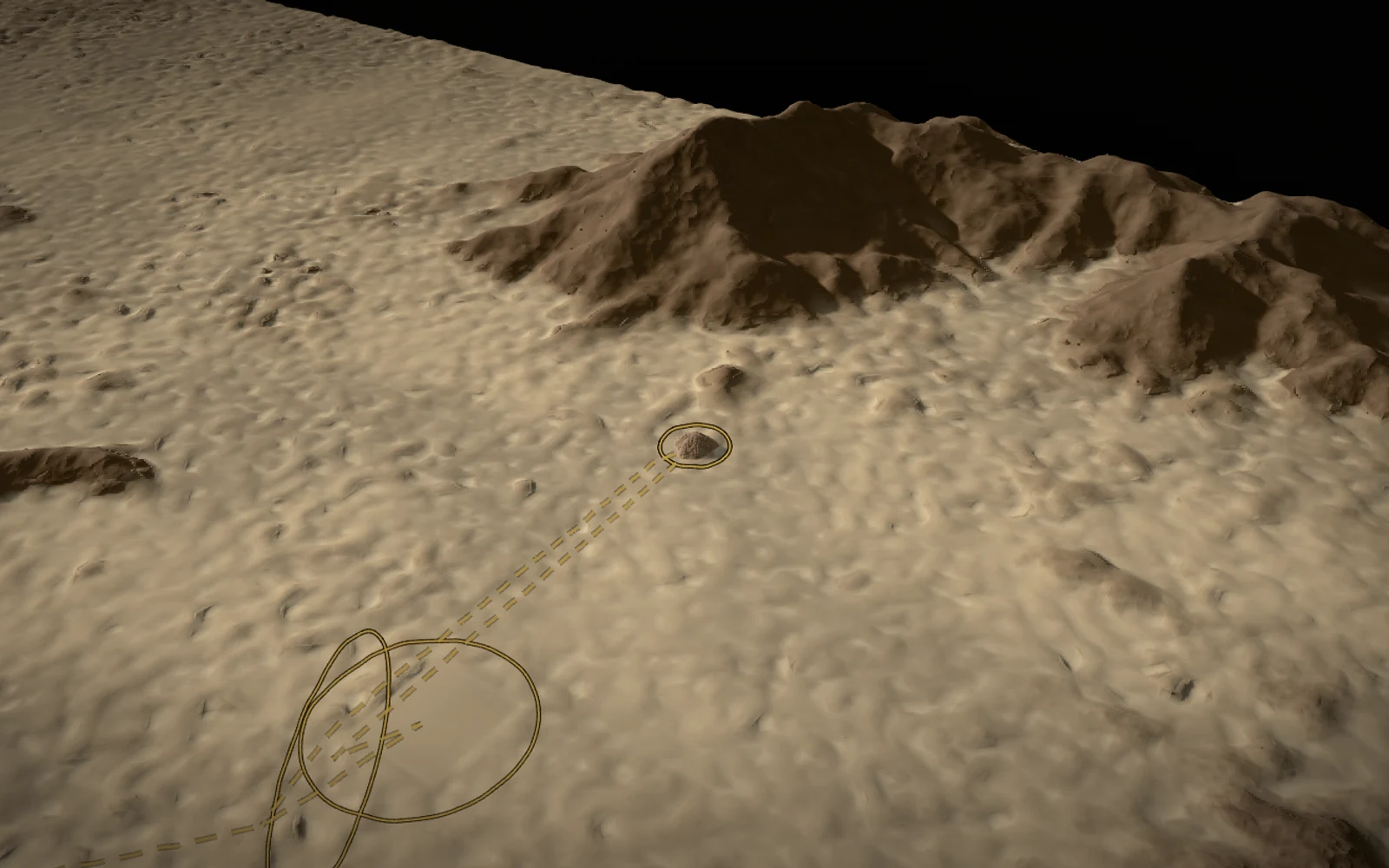
The model lays the days of the pilgrimage over some 23 km of valleys and granite hills: the camp in upper Makkah, the Day of Tarwiyah at Mina, the tent at Namirah, the sermon in the valley of Uranah, the standing below Jabal al-Rahmah until sunset, the night at Muzdalifah, the stoning, the sacrifice and the tawaf on the Day of Sacrifice, the days of tashriq and the farewell. The Farewell Sermon is given as text, each part at the place and on the day it was spoken, with its source. Every stop below gives its date, its sources and how sure its place is, and each one opens in the 3D model.
From Madinah to the camp in upper Makkah
The Prophet ﷺ left Madinah on 25 Dhu al-Qa'dah, with five nights of the month left, and reached Makkah on the fourth of Dhu al-Hijjah (Sahih al-Bukhari 1545). At Dhu al-Hulayfah he entered the state of ihram, and at al-Bayda' he raised the talbiyah from his camel al-Qaswa; Jabir ibn Abd Allah ﵁ looked out over riders and people on foot as far as his eye could see (Sahih Muslim 1218). The sahih reports give no number for them.
He entered Makkah by the upper pass (Sahih al-Bukhari 1576), made the tawaf and the sa'y, and camped in the bed of the wadi in upper Makkah, near al-Hajun, until the Day of Tarwiyah. Those who had brought no sacrificial animals left the state of ihram; he kept his (Sahih Muslim 1218).
The town itself, with the Ka'bah, Safa and Marwa and the valley around them, is on the Makkah in 3D page; this model sets the same interpretive town in the wider landscape of the Hajj.
The Ka'bah: arrival, ifadah and farewell

The Prophet ﷺ had set out from Madinah on 25 Dhu al-Qa'dah, with five nights of the month left, and reached Makkah on the fourth of Dhu al-Hijjah (Sahih al-Bukhari 1545). He entered by the upper pass (Sahih al-Bukhari 1576), went to the House and made the tawaf, walking briskly in the first three circuits, prayed two rak'ahs behind the Station of Ibrahim ﵇ and went out to Safa for the sa'y (Sahih Muslim 1218). Those who had brought no sacrificial animals left the state of ihram; he kept his, and did not come back to the Ka'bah until he had returned from Arafat. On the Day of Sacrifice he rode back for the tawaf of ifadah and drank from Zamzam, drawn for him by Banu Abd al-Muttalib, and at the end of the pilgrimage he made the farewell tawaf (Sahih al-Bukhari 1756) and then set out for Madinah.
- Location
- The mapped Ka'bah (OpenStreetMap) · position: high confidence
- Reconstruction
- The Ka'bah and the town around it are the interpretive settlement of the Makkah model of 610 to 615 CE, set on this terrain; the town of 10 AH is not surveyed. Where he prayed Zuhr on the Day of Sacrifice the reports differ: in Makkah in the account of Jabir ﵁ (Sahih Muslim 1218), at Mina in the account of Ibn 'Umar ﵄ (Sahih Muslim 1308). The hour of the last departure, at the end of the night of the 14th, is approximate.
- Sources
The camp at al-Abtah
From the arrival until the Day of Tarwiyah the Prophet ﷺ camped in upper Makkah near al-Hajun, in the broad bed of the wadi that the sources call al-Abtah or al-Batha. He stayed in ihram and did not go back to the Ka'bah until after Arafat (Sahih al-Bukhari 1545).
- Location
- Upper Makkah near al-Hajun, estimated from the mapped al-Ma'la cemetery · position: approximate (ring of 500 m)
- Reconstruction
- The sources place the camp no more closely than upper Makkah, near al-Hajun. The ring of 500 m is drawn around a point about 430 m east-north-east of the mapped cemetery of al-Ma'la, in the wadi bed; the modern city covers the whole area.
- Sources
- Sahih al-Bukhari 1545, sunnah.com ↗
- OpenStreetMap relation 6046910 (al-Ma'la cemetery, the anchor of the estimate)
The Day of Tarwiyah at Mina
On Thursday the eighth the pilgrims went out to Mina, a valley about 5 km east of the Ka'bah. The Prophet ﷺ prayed the five prayers from Zuhr to Fajr there and waited for the sun to rise, and gave word for a tent of hair to be pitched for him at Namirah (Sahih Muslim 1218).
Mina: the Day of Tarwiyah

On the Day of Tarwiyah the pilgrims set out for Mina. The Prophet ﷺ rode there and prayed Zuhr, 'Asr, Maghrib and 'Isha in the valley, spent the night, and prayed Fajr there on the morning of the ninth, waiting until the sun had risen; he had given word for a tent of hair to be pitched for him at Namirah (Sahih Muslim 1218). No building stood in the valley then.
- Location
- The valley of Mina (OpenStreetMap, the modern signed area) · position: high confidence (valley), medium (edges)
- Reconstruction
- Mina runs from Jamrat al-'Aqabah to Wadi Muhassir in the classical description of its bounds. The label stands on the mapped centre of the modern signed area; where in the valley he camped is not recorded. The mosque of al-Khayf, the tent city, the bridges and the railway are later and are not drawn.
- Sources
- Sahih Muslim 1218, sunnah.com ↗
- Jami' al-Tirmidhi 881, sunnah.com ↗
- OpenStreetMap node 7758270150 and way 1249259763 (the modern signed area)
Namirah and the sermon in the valley of Uranah
On the morning of the ninth he rode east past al-Mash'ar al-Haram, where Quraysh had expected him to stop as they did in the Jahiliyyah, and came to Arafat, to the tent at Namirah. When the sun had passed its height he rode down into the bed of the valley, which al-Nawawi ﵀ identifies as Uranah, just outside the boundary of Arafat as most scholars place it, and spoke to the people (Sahih Muslim 1218).
The Farewell Sermon as it is often quoted joins words spoken on different days. The hadith collections preserve this part from the valley of Uranah on the Day of Arafah; other parts come from Mina on the Day of Sacrifice and the days after.
Batn Uranah, Friday 9 Dhu al-Hijjah 10 AH (6 March 632 CE)
Sahih Muslim 1218, narrated by Jabir ibn Abd Allah ﵁
‘Your blood and your wealth are sacred to you, as sacred as this day of yours, in this month of yours, in this land of yours.’
‘Behold: every matter of the Jahiliyyah lies abolished beneath my feet.’
‘The blood claims of the Jahiliyyah are abolished. The first of our own blood claims that I abolish is the blood of Ibn Rabi'ah ibn al-Harith, who was being nursed among Banu Sa'd when Hudhayl killed him.’
‘The usury of the Jahiliyyah is abolished. The first usury I abolish is our own, the usury of al-Abbas ibn Abd al-Muttalib ﵁: all of it is abolished.’
‘Fear Allah concerning women, for you have taken them under the security of Allah and made them lawful to you by the word of Allah. Your right over them is that they let no one you dislike onto your bedding; if they do, you may strike them, but not in a way that injures. Their right over you is their provision and their clothing, in fairness.’
‘I have left among you that which, if you hold fast to it, you will never go astray after it: the Book of Allah.’
‘You will be asked about me, so what will you say?’ They said: “We bear witness that you have conveyed, fulfilled and counselled sincerely.” He raised his forefinger to the sky and turned it toward the people: ‘O Allah, bear witness. O Allah, bear witness,’ three times.
The opening words in Arabic: إِنَّ دِمَاءَكُمْ وَأَمْوَالَكُمْ حَرَامٌ عَلَيْكُمْ كَحُرْمَةِ يَوْمِكُمْ هَذَا فِي شَهْرِكُمْ هَذَا فِي بَلَدِكُمْ هَذَا (Sahih Muslim 1218).
After the sermon the adhan was given, and he prayed Zuhr and 'Asr together, with an iqamah for each and nothing between them.
The tent at Namirah
After sunrise on the Day of Arafah the Prophet ﷺ rode east from Mina. Quraysh expected him to halt at al-Mash'ar al-Haram, as they had done in the Jahiliyyah, but he passed on until he came to Arafat, found the tent of hair pitched for him at Namirah, and stayed in it until the sun had passed its height (Sahih Muslim 1218).
- Location
- The site of Masjid Namirah (OpenStreetMap), a later building · position: approximate (ring of 400 m)
- Reconstruction
- No source places the tent to the metre, and no tent is drawn. The ring of 400 m is drawn around the site of Masjid Namirah, a later building that is not drawn; the area called Namirah is wider, and the hill of that name stands about 1.9 km to the west. The elevation data recorded the mosque as a raised block of about 10 m, so the ground under its site is levelled back to the surrounding wadi floor.
- Sources
- Sahih Muslim 1218, sunnah.com ↗
- OpenStreetMap way 112317307 (Masjid Namirah, a later building)
- Wikidata Q12242853
The sermon in Batn Uranah

When the sun had passed its height he had al-Qaswa saddled, rode down into the bed of the valley and addressed the people; then the adhan and the iqamah were given and he prayed Zuhr, then 'Asr after a second iqamah, with nothing prayed between them (Sahih Muslim 1218).
- Location
- The bed of Wadi Uranah (OpenStreetMap), just outside Arafat · position: approximate (band along the wadi)
- Reconstruction
- Sahih Muslim 1218 says only that he came to the bed of the valley; al-Nawawi ﵀ identifies it as Wadi Uranah, which most scholars place just outside the boundary of Arafat. The band follows the mapped bed of the wadi beside the site of the Namirah mosque for about 0.8 km; the spot where he spoke is not known, and the western part of the later mosque covers the wadi bed today. The sermon is given here as text only, with its source.
- Sources
- Sahih Muslim 1218, sunnah.com ↗
- Sahih Muslim 1218c, sunnah.com ↗
- OpenStreetMap way 116953230 (the bed of Wadi Uranah)
The standing at Arafat
From the valley he rode on to the standing place at the rocks, at the foot of the small granite hill in the plain that is now called Jabal al-Rahmah, and stood there facing the qiblah until the sun had set (Sahih Muslim 1218). That Friday the verse was revealed: ‘Today I have perfected your religion for you’ (al-Ma'idah 5:3), as 'Umar ﵁ later confirmed (Sahih al-Bukhari 45).
The hill is about 65 m high above the plain and some 640 m around its foot, too small for the elevation data, which shows it as a lump of 14 m. It is therefore drawn as a separate model at its published height, with an interpretive outline, and a ring marks the foot where the rocks were, since the sources do not say on which side.
The standing at Arafat, below Jabal al‑Rahmah

After the prayers he rode on to the standing place and halted with his camel against the rocks at the foot of the hill and the path of those on foot (Habl al-Mushat) in front of him, facing the qiblah, and he stayed there until the sun had set (Sahih Muslim 1218). He did not stand on the summit, and on this Friday the verse was revealed: ‘Today I have perfected your religion for you’ (al-Ma'idah 5:3), as 'Umar ﵁ later told a man who asked about it (Sahih al-Bukhari 45).
- Location
- Jabal al-Rahmah (the mapped summit), the hill drawn from its published height and perimeter · position: high confidence (the hill); the spot at its foot is not known (ring of 160 m)
- Reconstruction
- Jabal al-Rahmah: about 65 m above the plain (Saudipedia). The terrain data here is too coarse to show a hill this small, so the hill is drawn as a separate model on top of it; its outline is interpretive. The rocks where he stood lay at the foot of the hill, on a side the sources do not give, so the ring is drawn around the whole foot. The hill stands on the terrain at its published height of 65 m: the ×1.5 exaggeration lifts it with the ground and never scales it. The white pillar, the stairs and the paving on the hill are modern and are not drawn, and the path of those on foot is not located.
- Sources
- Sahih Muslim 1218, sunnah.com ↗
- Sahih al-Bukhari 45, sunnah.com ↗
- Sahih Muslim 3017, sunnah.com ↗
- Qur'an, quran.com ↗
- Saudipedia, "Jabal al-Rahmah": about 65 m above the plain, 640 m around
- Al Jazeera Encyclopedia, "Jabal al-Rahmah", 23 September 2015: about 65 m, 640 m around
- OpenStreetMap node 1236463804 (the summit)
The night at Muzdalifah and the dawn at al-Mash'ar al-Haram
At sunset he left Arafat with Usamah ibn Zayd ﵁ riding behind him and called for calm; at a pass on the way he stopped to make a light ablution (Sahih Muslim 1218; Sahih al-Bukhari 1667). At Muzdalifah he joined Maghrib and 'Isha and slept until the dawn, and after Fajr he stood at al-Mash'ar al-Haram in supplication until the sky was bright, leaving before sunrise with al-Fadl ibn 'Abbas ﵁ behind him.
The pass is drawn at the narrowest point of the corridor that the terrain shows, a saddle measured for this model; the sources do not locate it more closely.
The pass on the way back
When the sun had set he left Arafat with Usamah ibn Zayd ﵁ riding behind him, holding al-Qaswa back and calling out to the people: ‘Calm, calm!’ (Sahih Muslim 1218). At a mountain pass on the way he dismounted, relieved himself and made a light ablution, and when Usamah ﵁ spoke of the prayer he answered: ‘The prayer is ahead of you’ (Sahih al-Bukhari 1667).
- Location
- The narrowest cross-section of the corridor in the terrain data (measured) · position: approximate (band)
- Reconstruction
- The hadith name a mountain pass (shi'b); the defile on this road is known as al-Ma'zimayn. The band marks the narrowest point of the corridor between Muzdalifah and Arafat in the terrain data, a saddle about 360 m wide some 2.5 km south-east of al-Mash'ar al-Haram, measured for this model. That the pass of the hadith lay exactly there is an assumption, and the model runs the way out and the way back through the same corridor. Modern road cuts have widened it.
- Sources
- Sahih Muslim 1218, sunnah.com ↗
- Sahih al-Bukhari 1667, sunnah.com ↗
- Farewell Hajj terrain data (SRTM via Terrarium z13), cross-sections measured 2026-09-24
The night at Muzdalifah

At Muzdalifah he prayed Maghrib and 'Isha together with one adhan and two iqamahs, praying nothing between them, and lay down until the dawn (Sahih Muslim 1218). The Islamic day begins at sunset, so this was already the night of the tenth, and the pilgrims slept on the open ground.
- Location
- Muzdalifah (OpenStreetMap place point) · position: high confidence (the area)
- Reconstruction
- Muzdalifah, also called Jam', is the plain between Wadi Muhassir and the defile toward Arafat; the label stands on its mapped place point. The lights, roads and stations of the modern plain are not drawn.
- Sources
- Sahih Muslim 1218, sunnah.com ↗
- Sahih al-Bukhari 1667, sunnah.com ↗
- OpenStreetMap node 4543956102
- Wikidata Q1788735
Al-Mash'ar al-Haram at dawn
He prayed Fajr as soon as the dawn was clear, then rode to al-Mash'ar al-Haram, faced the qiblah and supplicated there until the sky was very bright, and left before the sun rose, with al-Fadl ibn 'Abbas ﵁ now riding behind him (Sahih Muslim 1218). At Quzah he said: ‘This is Quzah, the standing place, and all of Jam' is a standing place’ (Sunan Abi Dawud 1935, graded hasan sahih by al-Albani ﵀).
- Location
- The site of Masjid al-Mash'ar al-Haram (OpenStreetMap), traditionally identified with Quzah · position: medium-low confidence
- Reconstruction
- The mosque of al-Mash'ar al-Haram traditionally stands at or next to the small rise of Quzah, and the point follows that tradition. The rise itself is too small to show in the terrain data. The mosque is a later building and is not drawn.
- Sources
- Sahih Muslim 1218, sunnah.com ↗
- Sunan Abi Dawud 1935, sunnah.com ↗
- OpenStreetMap way 457318293 (Masjid al-Mash'ar al-Haram, a later building)
The Day of Sacrifice
On Saturday the tenth he crossed Wadi Muhassir at a quicker pace, came to the jamrah by the tree and threw seven pebbles from the valley floor. He slaughtered sixty-three camels with his own hand and 'Ali ﵁ sacrificed the rest; then he rode to the House for the tawaf of ifadah and drank from Zamzam (Sahih Muslim 1218). Where he prayed Zuhr that day the reports differ: in Makkah for Jabir ﵁, at Mina for Ibn 'Umar ﵄ (Sahih Muslim 1308).
On this day he spoke to the people at Mina again.
Mina, Saturday 10 Dhu al-Hijjah 10 AH (7 March 632 CE, reconstructed)
Sahih al-Bukhari 1741 (Abu Bakrah ﵁), Sahih al-Bukhari 1739 (Ibn 'Abbas ﵄), Sahih al-Bukhari 4406 (Abu Bakrah ﵁) and Sahih Muslim 1297 (Jabir ﵁, at the jamrah)
‘Your blood and your wealth are sacred to you, like the sanctity of this day of yours, in this month of yours, in this land of yours, until the day you meet your Lord. Have I conveyed? O Allah, bear witness.’ (Sahih al-Bukhari 1741)
‘Let the one who is present convey it to the one who is absent, for the one it reaches may understand it better than the one who heard it.’ (Sahih al-Bukhari 1741)
To blood and wealth he added ‘and your honour’, and said: ‘Do not turn back after me into disbelievers, striking one another’s necks.’ (Sahih al-Bukhari 1739)
‘Time has come round to its form on the day Allah created the heavens and the earth. The year is twelve months, four of them sacred: three in succession, Dhu al-Qa'dah, Dhu al-Hijjah and al-Muharram, and Rajab of Mudar, between Jumada and Sha'ban.’ (Sahih al-Bukhari 4406)
At the jamrah, from his camel: ‘Take your rites from me, for I do not know whether I will perform Hajj after this Hajj of mine.’ (Sahih Muslim 1297)
Jami' al-Tirmidhi 2159, from 'Amr ibn al-Ahwas ﵁, also dates an address to the day of the greater Hajj, with the words that no one bears the crime of another; al-Tirmidhi ﵀ graded it hasan sahih.
Wadi Muhassir
Between Muzdalifah and Mina he crossed the bed of Wadi Muhassir, urging his camel on a little, and then took the middle road that comes out at the great jamrah (Sahih Muslim 1218).
- Location
- Wadi Muhassir (Wikidata) · position: medium confidence
- Reconstruction
- The dry stream bed is placed from its place record (Wikidata). A highway and tent grounds cover it today, and they are not drawn.
- Sources
- Sahih Muslim 1218, sunnah.com ↗
- Wikidata Q12250643
Jamrat al-'Aqabah and the Day of Sacrifice

At the jamrah by the tree he threw seven small pebbles from the bed of the valley, saying the takbir with each one (Sahih Muslim 1218). Then he went to the place of sacrifice and slaughtered sixty-three camels with his own hand, and 'Ali ﵁ sacrificed the rest, a hundred in all with those that 'Ali ﵁ had brought from Yemen; he said: ‘I sacrificed here, and all of Mina is a place of sacrifice’ (Sahih Muslim 1218). He had his head shaved (Sahih Muslim 1305), and he addressed the people at Mina that day.
- Location
- Jamrat al-'Aqabah (OpenStreetMap), where the site has continued · position: high confidence
- Reconstruction
- In 10 AH the jamarat were places where pebbles were thrown, Jamrat al-'Aqabah at the foot of a hillside; the hadith describe no pillar, and the model draws a low scatter of stones at each mapped site, its shape interpretive. The pillars, the walls and the bridge are later and are not drawn, and the hillside behind Jamrat al-'Aqabah has since been cut away. The elevation data shows a ridge of about 5 to 8 m along the valley floor here, probably the older bridge that stood in 2000; at this resolution it cannot be separated from the valley walls, so it is left as it is. The place of sacrifice (al-Manhar) is not located. The marker stands on the valley floor about 18 m south of the heap, where he would have faced it with the House on his left and Mina on his right (Sahih al-Bukhari 1747, from Ibn Mas'ud ﵁); the exact spot is not recorded.
- Sources
The days of tashriq and the farewell
For the three days of tashriq he stayed at Mina and stoned the three jamarat each day after midday (Sahih Muslim 1299), standing long in supplication after the first and the middle one (Sahih al-Bukhari 1751, 1753). In the middle of these days he addressed the people once more.
Mina, in the middle of the days of tashriq (8 to 10 March 632 CE, reconstructed)
‘O people, your Lord is one and your father is one. No Arab is above a non-Arab, nor a non-Arab above an Arab, nor a red man above a black man, nor a black man above a red man, except through taqwa. Have I conveyed?’
Musnad Ahmad 23489, from Abu Nadrah ﵀, from a Companion who heard it. Shu'ayb al-Arna'ut ﵀ judged its narrators trustworthy and its chain sahih in his notes to Sharh al-Tahawiyyah, no. 510, and Muqbil al-Wadi'i ﵀ graded it sahih in al-Sahih al-Musnad, no. 1523.
On the thirteenth he came down to al-Muhassab, prayed there and slept a little, and at the end of the night he made the farewell tawaf at the House (Sahih al-Bukhari 1756) and set out for Madinah.
The days of tashriq at the three jamarat
On the days of tashriq he stayed at Mina and stoned the three jamarat each day after midday (Sahih Muslim 1299), first the one that al-Zuhri ﵀ later called the jamrah next to the mosque of Mina, then the middle one, then Jamrat al-'Aqabah, standing a long time in supplication after the first two and not after the last (Sahih al-Bukhari 1751, 1753). In the middle of these days he addressed the people again.
- Location
- al-Jamrah al-Wusta (OpenStreetMap), where the site has continued · position: high confidence
- Reconstruction
- The middle jamrah stands at its mapped site, about 240 m east of Jamrat al-'Aqabah, drawn like the others as a low scatter of stones, interpretive. The weekdays of these days are counted from the Friday of Arafat.
- Sources
- Sahih al-Bukhari 1751, sunnah.com ↗
- Sahih al-Bukhari 1753, sunnah.com ↗
- Sahih Muslim 1299, sunnah.com ↗
- OpenStreetMap node 4144223249
- Musnad Ahmad 23489 (the address in the middle of the days of tashriq)
Al-Jamrah al-Sughra
The first of the three jamarat he stoned on each of the days of tashriq, the one farthest from Makkah. After it he moved a little ahead and stood facing the qiblah in long supplication, as he did after the middle one (Sahih al-Bukhari 1751, 1753).
- Location
- al-Jamrah al-Sughra, also called al-Ula (OpenStreetMap), where the site has continued · position: high confidence
- Reconstruction
- Drawn as a low scatter of stones at the mapped site, interpretive. The pillar and the bridge are later and are not drawn.
- Sources
- Sahih al-Bukhari 1753, sunnah.com ↗
- Sahih al-Bukhari 1751, sunnah.com ↗
- OpenStreetMap node 4144223248
Al-Muhassab
On the day he left Mina he came down to al-Muhassab, the broad gravel bed that the sources also call al-Abtah and Khayf Bani Kinanah, prayed Zuhr, 'Asr, Maghrib and 'Isha there and slept a little; then he rode to the House for the farewell tawaf (Sahih al-Bukhari 1756) and set out for Madinah. That night 'A'ishah ﵂ went out to al-Tan'im to make her 'umrah (Sahih al-Bukhari 1561).
- Location
- The modern district of al-Mu'abdah, from the description of al-Azraqi ﵀ · position: approximate (ring of 800 m)
- Reconstruction
- Al-Azraqi ﵀ describes al-Muhassab as running from al-Hajun upward toward Mina; the ring of 800 m is drawn around a point in the modern district of al-Mu'abdah, an estimate. The announcement at Mina that they would stop at Khayf Bani Kinanah ‘tomorrow’ (Sahih al-Bukhari 1590) is read in two ways, so it is given no date here.
- Sources
- Sahih al-Bukhari 1756, sunnah.com ↗
- Sahih al-Bukhari 1561, sunnah.com ↗
- Sahih al-Bukhari 1590, sunnah.com ↗
- al-Azraqi, Akhbar Makkah (the extent of al-Muhassab)
- OpenStreetMap relation 19262657 (al-Mu'abdah)
Other wordings of the sermon, and their grades
Ibn Ishaq ﵀, in the recension of Ibn Hisham ﵀, gives the sermon as one address at Arafat that also holds words the hadith collections place at Mina. Two endings of the saying about what he left behind him, and one further line, are reported with other chains and other gradings; they are listed here, each with its grade, and not on the cards.
Jami' al-Tirmidhi 3786 (Jabir ﵁): ‘the Book of Allah and my family, the people of my house’. Al-Tirmidhi ﵀ called it hasan gharib.
Ibn Ishaq ﵀ and the Muwatta of Malik ﵀ (without a chain) give ‘the Book of Allah and the Sunnah of His Prophet’; al-Hakim ﵀ gives it with chains that scholars grade differently.
Ibn Ishaq ﵀ also reports, without a connected chain: ‘Whoever holds a trust, let him return it to the one who entrusted it.’
Dating the Farewell Hajj
'Umar ﵁ said that the verse of al-Ma'idah was revealed at Arafat on a Friday (Sahih al-Bukhari 45). That Friday fixes the days: the ninth of Dhu al-Hijjah 10 AH fell on 6 March 632 CE, and every other weekday on this page is counted from it. The months were fixed by the sighting of the new moon, so no calendar converter decides these dates; the page gives them in the Julian calendar, which historians use for 632, and a proleptic Gregorian date would be three days later.
The sources name the days by their rites: the Day of Tarwiyah on the eighth, the Day of Arafah on the ninth, the Day of Sacrifice on the tenth, and the days of tashriq from the eleventh to the thirteenth. The departure from Madinah fell on 25 Dhu al-Qa'dah, with five nights of the month left (late February 632 CE). In the sermon at Mina he said that time had come round to its form on the day Allah ﷻ created the heavens and the earth (Sahih al-Bukhari 4406).
How this landscape was reconstructed: what is known, what is assumed
Every place has a coordinate from OpenStreetMap or Wikidata or, where nothing is mapped, a position estimated from a description in the sources, with its reasoning given in its block above. Where the sources name a place and it is mapped with medium or high confidence the route is solid; elsewhere it is dashed, and it passes through valley-floor points taken from the terrain. Places known only approximately carry a ring or a band.
The terrain is modern public elevation data (SRTM, flown in February 2000), sampled every 18 m and exaggerated ×1.5. Before anything was edited, the modern structures that stood in 2000 were measured: Masjid Namirah showed as a raised block of about 10 m and is levelled back to the surrounding wadi floor; the older Jamarat bridge probably shows as a ridge of about 5 to 8 m that cannot be separated from the valley walls at this resolution, and is left as it is; the road cuts cannot be undone. Jabal al-Rahmah is drawn as its own model at its published height of 65 m, never exaggerated. The buildings of Makkah come from the Makkah model of 610 to 615 CE, the same houses set on this terrain; no person, animal or tent is drawn, and nothing built after 632 CE.